
Unusual Operations
From time to time you may notice an unusual aircraft operation at or around the airport. Below are a number of examples of unusual operations that you may see at East Midlands Airport.
Go-arounds or missed approaches
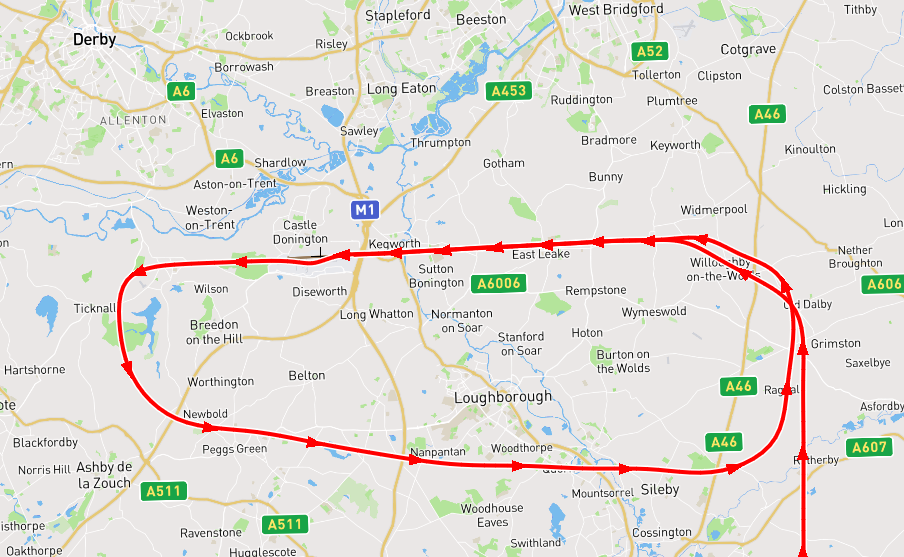
A go-around, or missed approach, can occur for many reasons such as, an obstruction on the runway preventing the aircraft from landing safely, a change in the wind conditions or that the aircraft cabin is not secure for landing. When coming into land, if a go-around is initiated, the pilot will apply thrust to climb straight ahead and then either turn left or right. Because a go-around can occur at any stage of the approach, the climb and turn could occur before or after reaching the runway. The exact path taken by an aircraft going around will be dependent on surrounding air traffic, the weather, the direction of operation and the point at which it is initiated.
The aircraft will take a wide orbit around the airport and then Air Traffic Control will then position the aircraft to make a second approach to the runway to land. This may mean that aircraft performing a go-around could overfly areas they do not normally at potentially lower than expected altitudes. Go-arounds are a rare occurrence at East Midlands Airport.
You can find out more by watching this video:
An example of a go-around on Runway 27 (Westerly Operations) can be seen below. As you can see the aircraft took a left turn and orbit around to re-establish for a second, successful, approach on to Runway 27:
Aircraft Holding
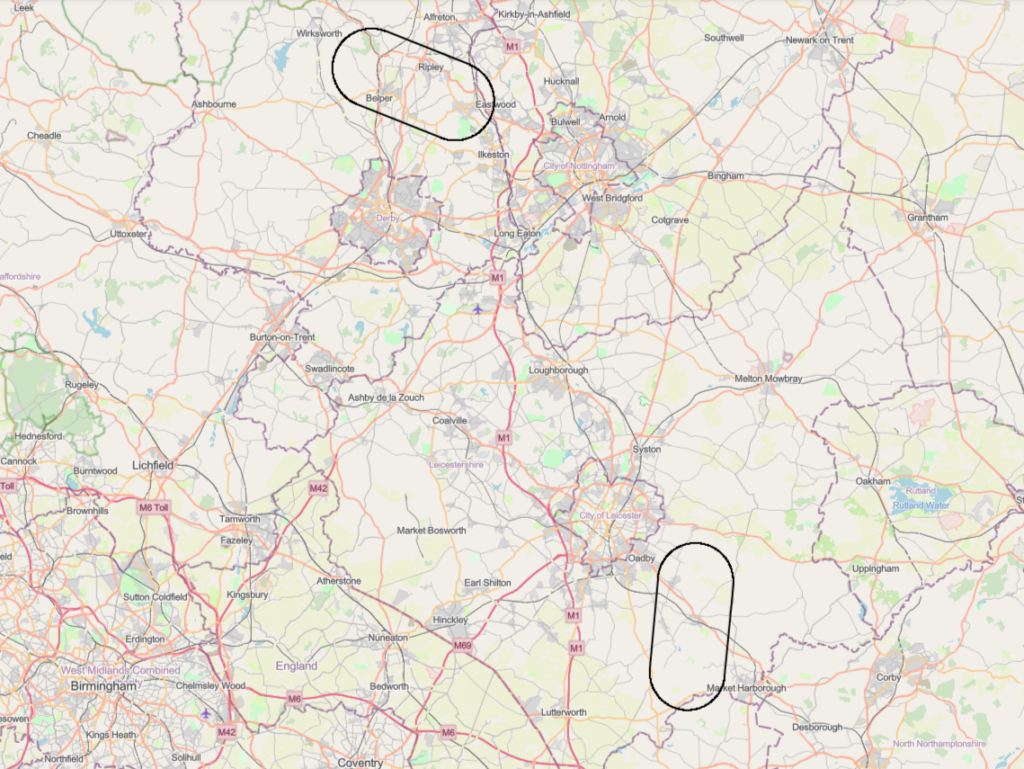
On occasion, often at busy times or during adverse weather, it will not be possible for aircraft to approach and land at East Midlands Airport without having to be held for a short period of time. This takes place in fixed oval pattern known as a stack or hold.
East Midlands Airport has two holding stacks; one called ‘PIGOT’ which is located South of Leicester and the second, ‘ROKUP’ is located Northwest of Nottingham. The stacks were located here in 2005 after an extensive period of airspace consultation in 2004 and CAA approval of the change. The minimum altitude of aircraft in the stack is 8,000ft and is set to keep noise on the ground as low as possible. The holding stacks are not used very often at East Midlands Airport as aircraft are usually able to land without delay.
You can find out more by watching this video:
Military Flights
On occasions, military aircraft use East Midlands Airport. As military aircraft sometimes need to divert to civilian aerodromes, it is important that pilots are familiar with the procedures at civilian airports, as they will differ from military bases. Due to the nature of their purpose, these aircraft, in particular fighter jets, are not designed with any noise-reducing features so their noise profile can be particularly loud. We are limited in our ability to mitigate against the noise impacts of these types of aircraft.
Helicopter Operations
Most helicopters operating at East Midlands Airport operate under ‘Visual Flight Rules’ and do not fly the Noise Preferential Routes (NPRs) when departing as commercial jet aircraft do. Similarly, helicopters do not arrive in the usual patterns seen with commercial jet aircraft. The pilot navigates using “visual” ground-based features such as roads and rivers etc. Examples of helicopter operations include Air Ambulances as well as helicopter operators passing through East Midlands Airport airspace.
Air Charters
Occasionally you may see some unusual freight aircraft. An example of which is the AN-124. The AN-124 is one of the largest aircraft in the world, specifically designed for carrying heavy or bulky loads. Equipped with a high volume of cargo capacity, drive-on loading ramps and a variety of built-in freight handling equipment. These are specialist aircraft used for carrying abnormal cargo which do not fit in the regular cargo aircraft seen at East Midlands Airport.